Sunday, July 3, 2016

The Trouble With Species

This summer, part of my research involves determining what makes a species... well, a species.

Sounds easy enough, right? Obviously a penguin is extremely different from, say, a dragonfly. There's no way that you could have a half penguin, half dragonfly animal. Not without some really weird Frankenstein-style 'science,' anyway. And even then, probably not.

But what about two different kinds of penguin? Or a mammoth and a mastodon? Dog and wolf? Or even two different types of seagulls?

And so it gets progressively complicated as you get into closer and closer cousins.

This actually started to really bother me within the past school year. In my ornithology class, we were out identifying birds at one of NC's beaches, and I really began to struggle with the multiple types of seagulls. Referring to my birding book, I came across a page talking about two of the different types having a hybrid with slightly different markings. Not a hybrid like a mule, the mix of a horse and a donkey that can't reproduce, but a hybrid that is a fully functioning animal with slightly different markings. When I asked my professor about this, very confused by the fact that it seemed that everything that I had ever learned about biology was falling apart, I found out that birds frequently get classified this way for the sake of field identification; we identify them based on markings, whether that affects their ability to breed or not. Based on region, such as an eastern and western species of pheobes and blue birds, despite there being areas of overlap where hybrids are common.

Basing it on the frequency of these hybridizations in comparison to when they don't happen.

Biology just got ridiculously complicated and subjective right there.

The trouble is, depending on just what field of biology you go into, the definition of a species may vary. It also may just get tossed in the garbage completely.

Some of the definitions include:

The biological species concept- the idea that if two animals can reproduce and have offspring that can reproduce, they are one species. This may or may not include two animals that would never run into in nature, such as two pigeons on different continents. It depends on how you need to study them. This one poses a problem when you run into fossils, where we can't test this, and when you hit things like wolves and coyotes and dogs that can reproduce together but normally don't.

A famous but false example of one of these hybrids is Balto. Though the fictional stories calls him a wolf-dog, history says he was just a very hardy Siberian husky. However, the story does differentiate between the regular dogs and a wolf-dog, because while a mix can function, they're known for having a slightly different build or temperment from either parent. More so than would normally be caused by individual variation. So are dogs and wolves one species?

This is getting to be a bigger problem back home with the rise of red wolves and the increasingly common mix between coyotes and them. Its a conservation problem: red wolves are protected, and coyotes have a bad reputation. Grouping them into one species makes it harder to protect one, but based on the biological concept they are one.

And then you have the problem of animals that don't reproduce together as a result of a difference in mating season, slight differences in courtship, or just because there happens to be a mountain, body of water, or a road in the way. Are these different, even if in captivity they recognize each other?

The cladistic or evolutionary concept: based on a group of animals that are closely related, more or less. This method helps paleontologists, as well as geneticists. The problem here: who has the right to draw that line? If you ask biologists where to draw it, some of them will wave their arms and come up with an arbitrary line. Others will look disturbed and admit to it being arbitrary.

The morphological concept: this species concept is based on shape. This is sort of easy for paleontology, at least when the bones reflect the differences. The idea is that two animals of one 'morphotype' will be one species.

But then... what about big and small dogs, or two dinosaurs that may or may not have a crest? Or two animals that have slightly different markings but are viable if they can just recognize each other as the same?

A good example of this one in the fossil record is that of the neandertals and Homo sapiens (us, in case you need to know!!) The two are very different based on the bones alone. For a long time, they were called two separate species until someone managed to get DNA and found that we actually have some of their DNA in us. Most now consider them a "subspecies," or Homo sapiens neandertalis. Basically, us, but with a slightly different build and face.

And these aren't the only definitions, just the simplest ones.

Personally, the biological concept always made the most sense to me. It was testable, and if the exceptions were really classified based on a simple "yes these work" or "no these don't," it was a good, clean-cut method. Unfortunately there isn't a way to test this with extinct species. In addition, plants are SUPER complicated; you can cross many of them, graft others, combine some that you'd never expect, and them do things that animal chromosomes just can't handle. And bacteria are even weirder; they eat each other, and can frankly pick up and dispose of and reproduce any gene they have a mind to when its available.

Oh yeah. And then you get to viruses. That's another debate entirely.

Basically my conclusion after this semester is that we really don't know what we're doing. There needs to be a good, solid concept of a species for biology to advance, but no one has been able to pose a definition with no exceptions that works. Some fields of biology don't need a definition, but many do. And it needs to be something representative of life, as it was and is and could be, in any form.

Confused yet?

Wednesday, June 29, 2016

Watch it, then see it!


What do these two places have in common?

I'll give you a hint.

One is a picture of NYC. The other is Zion National Park in Utah.

Still confused?

Isn't it obvious? The correct answer is: I've been there!!

Actually, they have something else in common: both have geology that tell about the story of our continent. Completely different parts of the story, mind you, but parts that are well knitted together by a special that PBS just aired tonight. Highly recommend that you watch it, by the way. PBS, I think, tends to do a pretty phenomenal job with their illustrations and video. It makes the science very approachable.
http://www.pbs.org/wgbh/nova/earth/making-north-america.html#north-america-origins

Let me just say that things get really interesting when you start seeing more and more places that you've been on geology/paleontology TV specials.Its one thing to see these places on TV. But you really have to explore them for yourself to understand their vastness. On foot, by my preferences, with a camera.

Saturday, June 25, 2016

Even older mummies

There are two kinds of mummies.

One kind is intentional, made to honor and remember past relatives and preserve them for as long as possible. The Egyptians were known for doing this and then entombing them deep in pyramids that are nothing short of architectural wonders. In our hemisphere, the Inca mummified their royalty in a sitting position and treated them not as honored dead but alive, and sought their advice. They even were known to take them to war with them. This is by no means an exhaustive description of similar practices, its only a small sampling with a couple of examples.

The other kind tends to be those that were preserved naturally, such as the Ice Man, an shepherd from ancient times that died in the heights of the mountains and was preserved until he melted out and archeologists found him. Also commonly known are the "bog people," men and women who were buried in layers of peat and found thousands of years later by men digging out peat for fuel. There's a lot of great reading on these guys.

Not all mummies are human though, as the word has come to encompass a greater range of ideas. In the same way as the Ice Man, mammoths frequently thaw out of icebergs in Russia, extremely well preserved and including their organs, hair, and tusks that are harvested in place of those of modern elephants.

We've also stretched out the term in paleontology to include exceptionally preserved fossils, especially those that still have some dimension to them and are at least partially surrounded with impressions or actual skin. It doesn't have to all be preserved, but all sides should have at least some on them. I'm only aware of about half a dozen of these, although I know of one specimen that has the potential to be one. That one hasn't be heavily studied nor published yet, though, so I'll put off being excited about that one and continue being a general skeptic. Regardless, when they do turn out to be the actual thing, they are extremely impressive and provide valuable information about aspects of the creature that we wouldn't otherwise be able to find out. Among other things is information about diet, not from the teeth but from, sometimes, actual stomach contents. With careful preparation, chemistry, and observation, pair with new tests coming into science, we learn more from these every time they are looked at.

Perhaps just because of how common the fossils are found, generally these are hadrosaurs, or the duck-billed dinosaurs. For some reason that we're really only beginning to figure out, their skin just preserves very well to begin with. I'm working on one at my museum back home currently that may provide some really interesting information, so this is very close to me. I love the preservation of these; it allows us to talk about how the animal lived and died, its ecology, its responses to its environment, and everything that makes animals.... well, animals.

If you decide you're super interested, because this really cool, there's a good book on dinosaur mummies called Grave Secrets of Dinosaurs: Soft Tissue and Hard Science. It was one of the first books I read on paleontology after all of the many picture books and "field guides" on dinosaurs. Its a great read.

By the way, the picture is of one of these awesome hadrosaurs that is at the American Museum of Natural History. This one actually looks like what you would think of as a mummy!!

Saturday, June 18, 2016

Migrations!

My sister came up to visit for a couple of days so that she could see the museum's planetarium and meet some of the astronomy and physics people. When she wasn't nerd-ing with them about things that are (literally) way over my head, we went out and were the ultimate tourists- Times Square, Chinatown, Brooklyn Bridge, and of course the Statue of Liberty.
Nowadays, if you're cheap tourists like us (or even if you aren't cheap), the best view of the Statue of Liberty is the half hour trip on the free ferry to Staten Island and back. They're pretty used to the occasional (frequent) tourist with a camera hanging over the railing, staring at what they see every day, being excited over a statue that's been standing in the same place every day for years.

Not so long ago in comparison to the age of the Earth, folks coming over from the other side of the Atlantic by boat had to go through NYC first. Many came hoping for work, to make their way in a new world, and to find something better than they left behind. Although I haven't had much luck tracing our family history, I wonder from some of the stories our great grandmother told us whether some of our family passed through Ellis Island, right next to Lady Liberty. Names got mixed up, and not everyone made it through the medical exams and questions needed to pass through. But people tried, because this is where they wanted to come. The boats would've been more packed, and cheers erupted as the smell of salt water gave way and the statue came into sight. It was the first view of America.
OK, OK, you say. It's a paleontology blog, don't start bragging about your country. Actually, Bea (my little triceratops friend) got really excited to see this. Her ancestors actually came from another continent too. Back in the age of dinosaurs, there was a connection between Asia and North America. My first impression of one of my professors was at a talk she gave about her research on dinosaurs that traveled from Asia to America this way. Cretaceous fossils found in the Midwestern states that we normally think of as 'ours' are directly descended from ones found in Asia, which suggests that there was a migration of dinosaurs from there that replaced those that were on the land that's now our country before that. There was no statue to greet them, and it was a much slower process, but the bones- just like the statue- have their own story to tell. We're just still teasing it apart.


Sunday, June 12, 2016

More specie-fically....


So Opie reminded me that while I talked a little bit about my project, I could have talked more about phylogenies and how we actually come up with these crazy trees.

Not trees like the ones across the street in central park. These are family trees, much like those you can make that describe your relationship to your parents and siblings. However, these describe similarities between species. More recently, this is done with genetics. However, the bones and genetics don't always line up perfectly. With birds, we haven't been able to figure out specific patterns with anything other than the genetics, but as they should be there, we keep looking.

It's good practice. We don't frequently have genetic data with fossils, and by finding the patterns in modern animals that we have entire skeletons for, we can look for the same patterns in the partial skeletons of fossilized ones.

We can put numbers to those similarities and differences, and then a computer can calculate their "closeness."

Pretty soon our little tree sprouts branches and offers information. This allows us to make guess about behavior, find patterns in function of different structures, and hypothesize about the parts of animals that don't fossilize. In modern animals, we use it to design experiments, depending on whether we need very similar or very different animals. Its one more method towards being able to tell a more complete story.

Wednesday, June 8, 2016

Sci Street


 Needless to say, I like science. And I like seeing people getting excited in science. So when I caught wind of an event going on last weekend, I decided to be a science nerd rather than the culture and history nerd that most of NYC encourages.

Of course, that meant being continuously run over and around by little kids half my size. But it also meant a lot of really interesting topics that were slightly outside of my field.

OK, very much outside of my field.

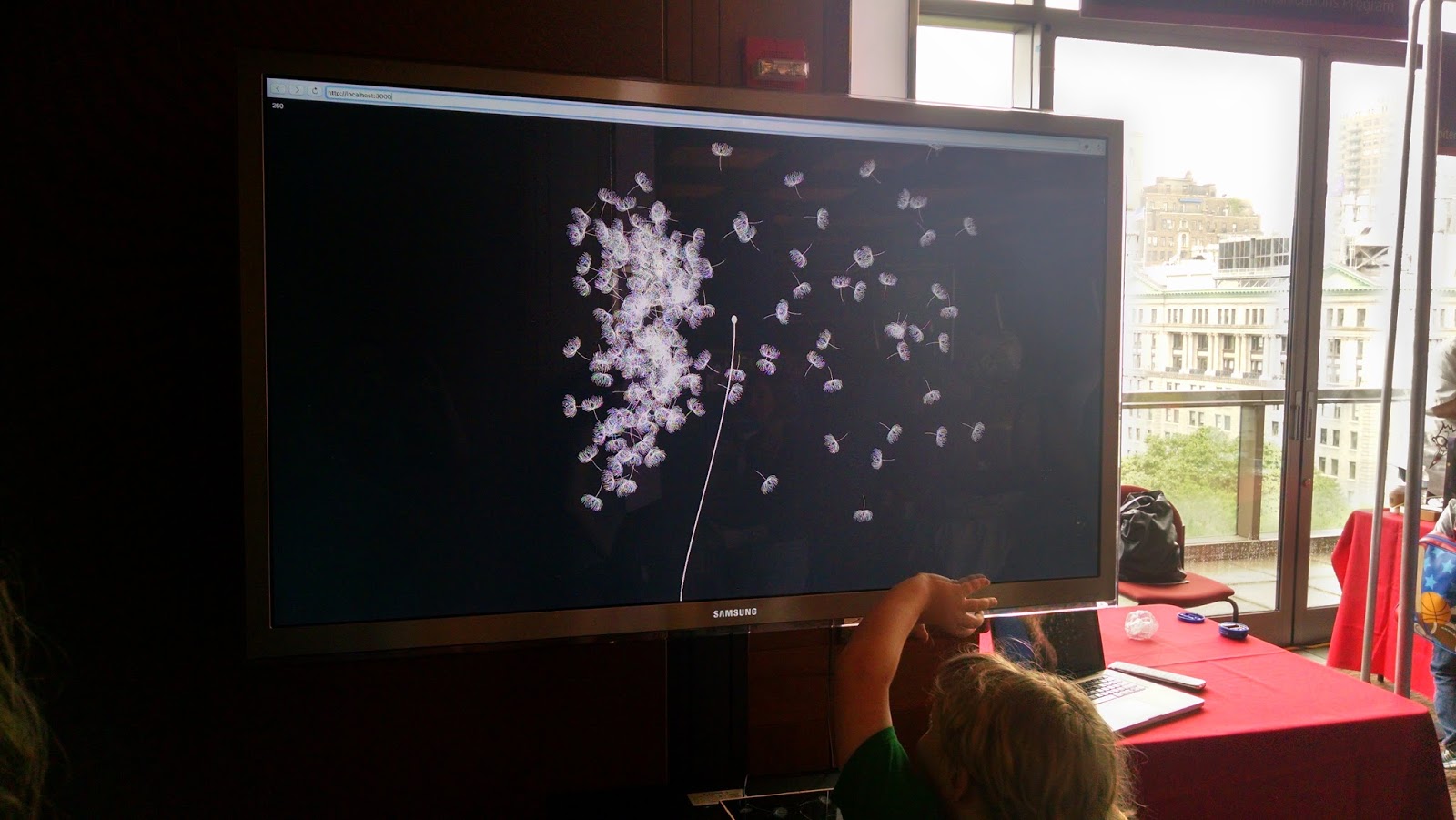
A couple of the demos were for the kids to understand the basic laws of physics, such as every action having an equal and opposite reaction, and a bus with a bunch of microscopes- including a scanning electron microscope like the ones that I've had the opportunity to use for research at home. There was a compute program using a dandelion to model wind, giant dominoes, a 'dragon 3-d simulator,' balloons that blew up due only to a basic chemical reaction, and a challenge to beat a record with this giant tesselation (a special kind of pattern.)

If you wanted something a little more to chew on, there was a lot of information about the bending of space-time and all objects actually having a small amount of gravitational pull of their own.

There were some pretty advanced physics concepts, and for once they actually made some kind of sense to me. For example, within the past year a study came out about two colliding black holes that, when sensed by some of our instruments on earth, actually gave some much needed evidence towards gravity. We knew it was keeping us from floating into space, but this helped us understand more about how it works.

There was also  information about studies done in Antartica to detect photons by scanning with instruments embedded in the ice. These can sense different fluctuations in these and learn about different events going on in space. It's aptly named; the instrument is called "IceCube."

This is way over simplified, but it actually was very well explained there. It has me and my suite mate wanting to visit the Museum of Math, which we didn't actually even know existed until this event. I'm excited to see what else they have in store.

To satisfy anyone who thinks I need to be doing the tourist thing, I took pictures of the Washington Arch and made my way down to the 9/11 memorial. My inner history nerd is satisfied, as is the patriotic child that remembers that day almost 15 years ago. The entire theme of the memorial though, was to both remember and to rebuild. And interesting folks in science is going to be a part of that.


Sunday, June 5, 2016

Another Summer, Another Place

This year, there is no field work. There are no nights under the milky way, no scorpions, and no monsoons threatening to steal my tent.

Instead, this is my summer view. And this is Opie, Floyd, and Bea deciding on what they want to do over the weekends that we'll be here. For some reason, before I got kind of tired of cities, I really wanted to come here when I was little. There was something magic about the Statue of Liberty. I may not like crowds, but its made up for by everything I want to explore here.


But there are no dinosaurs buried in NYC. At least.... none that I've heard of. Unless you count those that are buried in the collections of the American Museum of Natural History.

Look familiar? This is the home of Rexy, from Night at the Museum.

The museum is one of those that really got paleontology going. It is the reason that no one can forget Brontosaurus, and the home of Roy Chapman Andrews, who went from custodian to leading a field expedition to the Gobi desert. Its like Chicago; its one of those museums that has risen to being one of the most renowned institutes of paleontology.

This is where I'm interning this summer.

Funny story, though. I'm not actually interning in the paleontology department. I'm in ornithology, the study of birds. Why?

Well, I've been using the summers to try to narrow down what exactly I want to study in graduate school by studying a different animal group every summer. And the project this year happens to be studying the differences between the bones of different species, and using it to work out the relationships between birds, both fossil and modern. Now, the birds I'm working on are ones that you would actually recognize as birds if you stepped out of a time machine; they are not dinosaurs with feathers or that can even fly. You'd know these were birds, no questions asked. However, we are interested in the end of the Cretaceous and the time right after the meteor. Before the dinosaurs went extinct, there wasn't a very high diversity among the birds. Afterwards we find a lot of different species. What happened?

Frankly, we don't know. Its a research internship; the point is to study things we don't know. The extinction of the dinosaurs did open more niches, or roles in the environment, leaving them to be filled by birds and mammals. But that's about all we've got figured out at this point.

So I'm not working with the public this summer. But I'll be sure to dig up stories about birds, dinosaurs, the museum, and anything else science-y I can. Meanwhile, I'll be in a city I can't dig in, having a different kind of adventure.

My Story (Very briefly...)

Lots of people claim that they wanted to be paleontologists at the age of 3. So did I. The problem is, I never really grew out of it. My third birthday party had dinosaurs. Everywhere. I grew up digging in fossil dirt from Aurora, NC, looking for coral and shark teeth. I practically lived at my local science museums (and still do, only now I get to do research, fossil preparation, and work in collections!) When local paleontologists discovered a dinosaur with a "fossilized heart" (no longer considered such) when I was little, I got to meet the man who led the work. And then, years later a dinosaur bone with soft tissue turned up. I was officially hooked.
No longer was I dreaming about dinosaurs. I was actively pursuing the science behind prehistoric creatures. I didn't want to read about it, I wanted in on the action. So I started working at the museum, and finally going on my own adventures. And thus, I needed a place to share them and maybe inspire others the way I was inspired. I have gone from watching fossils be prepared from one side of the glass at the museum to working on them on the inside of the glass. I am a student working toward my goal. I can finally start to call myself a paleontologist.